Gelato v1 connects everyday devices to streaming intelligence through a common protocol. The engineering challenge is not only to move observations and commands between machines. It is to keep the authority to act explicit as devices reconnect, permissions change, and a model interprets untrusted input.
This report explains the architecture and the safety boundaries in the v1 contracts. For the original introduction, supported devices and full video, visit the Gelato product page.
Architecture and trust boundaries
Gelato separates local execution, coordination and model inference. The device implementation connects to a Controller through gelato.v1. An optional model runtime attaches to the Controller through a separate gelato.model.v1 session. A device does not need to know which model provider is in use, and a Controller can implement the device protocol without a model at all.
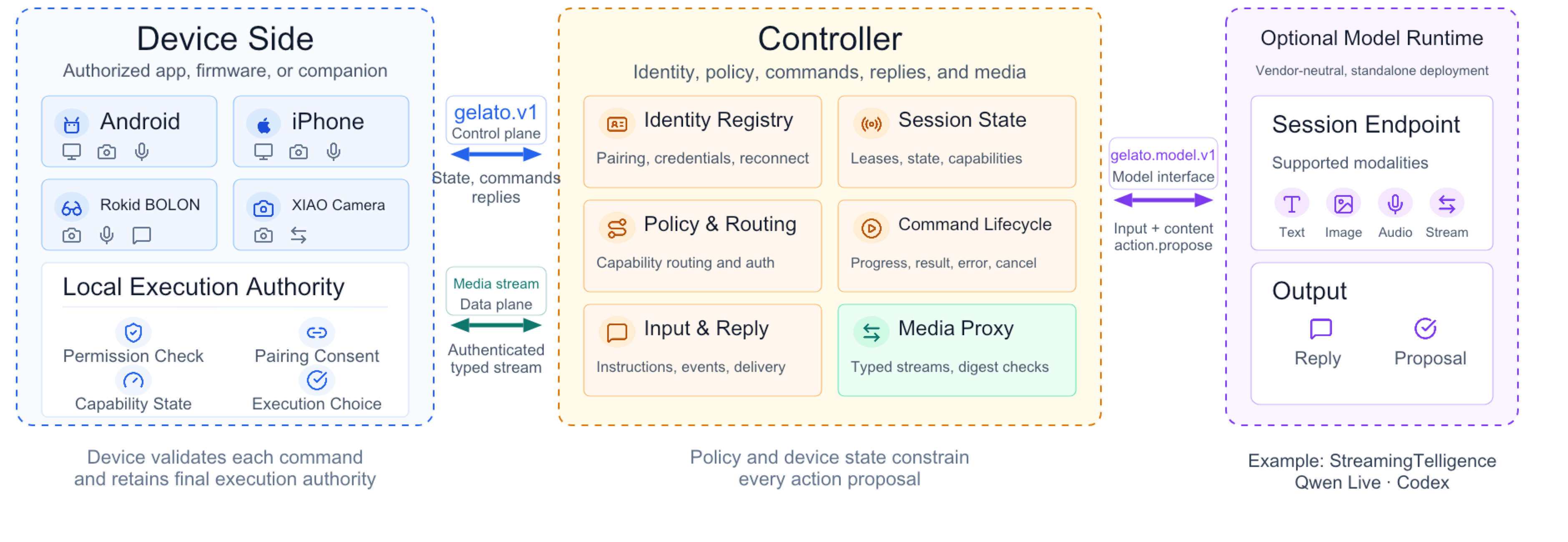
The device implementation owns the connection to real hardware or platform capabilities. It performs local prerequisite checks, advertises what is currently available, publishes inputs and decides whether a routed command may execute. It can be an app, firmware or an authorized companion; the protocol does not prescribe a separate driver process.
The Controller manages device identity, authenticated sessions, current capability snapshots, policy, command lifecycles, replies and media streams. It is the point where a requested action is checked against a specific device's current state. Its permission to route a command does not remove the device's obligation to check that command locally.
The model runtime receives inputs and produces content or action proposals. It has no device-pairing credentials and no direct connection to a device. Separating this interface lets developers change models while preserving the same device authorization boundary.
Pairing is not permission to control
A remembered device, a live connection and permission to act are three different states. Combining them into one “connected” switch would make a reconnect capable of silently restoring authority that an owner had withdrawn. Gelato represents them independently.
| State | What it permits | What turning it off means |
|---|---|---|
| Paired | An issued device identity and credential for later authentication | Revocation or an explicit reset removes that relationship |
| Connection enabled | The device may establish its Controller connection | The connection closes, while the pairing can remain |
| Control allowed | Advertised commands and control media, subject to local checks | Commands other than device.describe are rejected and control media stops |
Local control consent defaults off. The device reports it as hardware.controlAllowed; an absent value also means false. A paired, online camera can therefore remain unavailable for control. Platform permissions and capability readiness are additional checks, not consequences of pairing.
Before first pairing, the owner sees device-local prerequisite guidance and explicitly confirms pairing. A link may stage a service address and one-use code, but cannot silently grant permissions. The prerequisite model distinguishes a confirmed failure from an unknown condition: an evidenced, required failure blocks the relevant operation; an unknown condition does not prove readiness and must not be displayed as completed. Execution can still fail and must return a real command error.
Identity follows the device session
The device initiates its control connection. First pairing uses a one-use code; subsequent connections authenticate with the issued credential. Credentials do not belong in URLs. Remote connections use TLS-protected WebSocket, with unencrypted WebSocket reserved for loopback development.
A reconnect authenticates again and supplies a fresh capability snapshot. It cannot assume that the old connection's permissions, hardware availability or command state survived. Leases make presence time-bounded: the v1 contract specifies renewal every 10 seconds and treats a lease older than 35 seconds as stale.
The Controller routes against the current snapshot, including capability versions. A device's model name or family is not evidence that a particular action is available. This matters when, for example, a phone stays paired after a camera permission is removed. Local validation remains necessary even after Controller checks, because the device's state can change between routing and execution.
Model output is data, not authority
A model response can inform a user without authorizing a hardware action. reply.deliver is content, and reply.ack confirms local receipt—not that the user read, heard or approved it. The device must not interpret a reply as an executable command.
When a runtime supports actions, it emits action.propose. The Controller checks its own policy, the current device session, the advertised capability and local owner consent before creating a command.request. The device then checks the command again before execution. Only a confirmed terminal device result can be reported as a completed action.
This separation is particularly important when a camera sees text or a model consumes third-party content. Prompts, observations and model output remain untrusted data; none can replace owner authorization or supply a missing capability. The architecture places those checks outside generated text. It does not claim that a protocol alone eliminates prompt injection or application-level policy mistakes.
The model interface uses a separate service token, not a reused device credential. A runtime declares its supported modalities and action capability before input is sent. An observation-only integration must not be treated as a device-control integration, and one user's context should not be merged with another's merely because they share a device identifier.
Commands make uncertainty explicit
A command identifies a versioned capability, its arguments, an absolute deadline and an idempotency classification. The device may report progress, then returns exactly one terminal result or error. Cancellation is best-effort: it cannot reverse a physical action that has already happened.
Retries preserve the command ID and arguments. Reusing an ID with different arguments is an error. If a connection disappears after an action may have executed, the outcome is unknown; a timeout is not proof that nothing happened. Before issuing a replacement side-effecting action, the caller must inspect device state rather than blindly repeat it.
The same principle applies at the model boundary. Events carry session and turn identifiers, ordered sequence numbers and deduplication IDs. An interrupted turn cannot be assumed to have survived reconnection. These contracts let integrations distinguish a failed request from an uncertain physical outcome instead of hiding both behind an automatic retry.
Separate media transport from control
Images, screen observations and audio travel through authenticated, typed streams rather than being embedded in control JSON. Control messages refer to completed streams. Stream offers declare purpose, direction, content type and byte limits; completion checks the total size and SHA-256 digest.
This separates large media transfers from command lifecycles and gives receivers an explicit validation boundary. A checksum verifies integrity; it does not make media trustworthy instructions. An authenticated connection also does not imply permission to store every frame indefinitely.
For live image observations, the protocol supports complete images per message and optional source timestamps. Capture time is distinct from Controller receipt time. Immutable frame references, cursors and process epochs let consumers identify gaps after an overrun or restart. Each consumer owns its persistence and retention policy. In particular, a stream marked transient can be forwarded immediately, but that flag does not grant permission to persist it.
One contract across different hardware
Android phones, iPhones, Rokid BOLON glasses and the XIAO ESP32S3 Sense camera implement different subsets of capability. The glasses run their reference implementation locally and connect over Wi-Fi after commissioning. The camera board runs firmware on the board and uses a temporary local setup surface. Neither needs to impersonate a phone to join the same device pool.
A model adapter likewise exposes only what it implements. Text and image input, live audio and device-action proposals are distinct capabilities. The architecture keeps provider-specific inference choices behind the Controller-to-model interface, while hardware execution remains with the device or authorized companion.
Safety is a contract to verify
The repository's automated checks cover public protocol schemas, Controller behavior and maintained SDK paths without requiring external model credentials or physical hardware. These checks are useful evidence for the boundaries described here; they are not a certification of every device, network or deployment.
Physical-device release checks remain separate. They record pairing, reconnects, commands, cancellation and media behavior against a particular device, OS and Controller version. Deployment owners also need to make their own choices about policy, credential storage, retention and model access. Gelato supplies explicit interfaces for these decisions rather than treating a successful demo as proof of universal readiness.
Explore Gelato
Open the Gelato product page for the introduction and devices, or watch the full demo. To build an integration, start with the Gelato documentation and getting-started guide.
The architecture and protocol descriptions in this report follow the public Gelato repository: system architecture, device protocol, model session interface and testing policy. The repository contains the SDKs, schemas and reference implementations.